Work and learning
Make a Practice Quiz from Notes with AI: Answers Included
Make a practice quiz from notes with AI using source-linked answers, plausible distractors and retrieval practice. Includes a complete small quiz and review prompt.
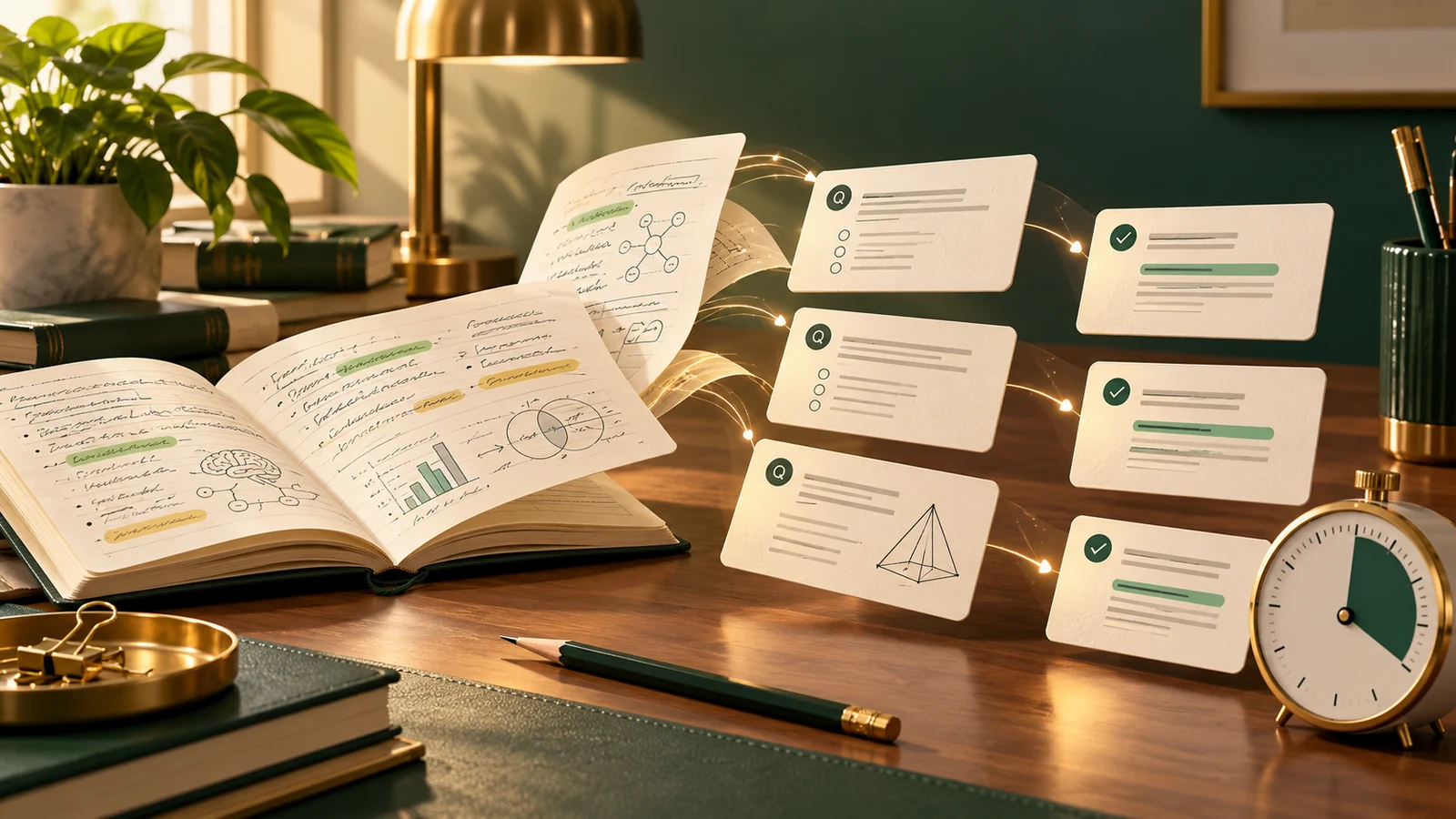
Make a practice quiz from notes with AI by providing the source material, the learning objective and the question types you need. Ask for an answer key linked to the notes and an explanation for each answer. Verify the questions before studying so you do not rehearse a generated mistake.
The purpose is retrieval practice: try to produce an answer before looking at it. A quiz can help you discover gaps, but its usefulness depends on accurate questions that match what you need to learn.
Choose a small source and a clear objective#
Start with a section of notes rather than a whole semester's material. Include headings and stable references such as page or paragraph numbers. Tell the model whether you need definitions, application questions or a mixture.
Check your institution's or instructor's rules for AI use, especially when course materials or assessments have restrictions. Use the workflow for your own permitted practice; do not ask it to reconstruct a confidential exam or misrepresent generated work as independent assessed work.
Use a source-grounded quiz prompt#
Create a practice quiz using only the notes below.
Learning objective: [objective]. Learner level: [level].
Notes with paragraph or page IDs: [paste].
Create [number] questions with a mix of short answer and application.
Keep questions separate from the answer key. For every answer, give
the supporting source ID and a brief explanation. For multiple choice,
use one clearly best answer and plausible distractors based on common
confusions. Do not add unsupported facts or ambiguous trick questions.
Flag unclear or conflicting notes instead of inventing an answer.
Ask for fewer well-checked questions before requesting a larger set. It is easier to spot ambiguous wording and source problems in a small quiz.
Try a complete miniature example#
Here are fictional study notes for a basic data-review lesson:
Paragraph N1: A row's meaning is its unit of analysis. A table with one row per message cannot be counted as one row per customer without additional processing.
Paragraph N2: A percentage equals its numerator divided by its denominator, multiplied by 100. When groups differ in size, the overall share should be calculated from combined counts.
Paragraph N3: Missing data is not automatically zero. The reporting rule should explain how missing values are handled.
| Question | Type | Skill checked |
|---|---|---|
| What does one row represent in a message export? | Short answer | Identify unit of analysis |
| Group A has 8 of 10 successes and B has 18 of 30. What is the combined share? | Calculation | Use combined counts |
| A missing response time is recorded as zero. What needs checking? | Application | Distinguish missing from zero |
Try answering before reading the key. For the first question, one row represents a message, based on N1. For the second, the combined share is 26/40 = 65%, based on N2. For the third, check whether zero is a real observed value or an unsupported substitution for missing data, based on N3.
Check the answer key independently#
Open the cited paragraph and confirm that it supports the answer. A source reference can be present but wrong. Recalculate numerical answers and inspect whether a multiple-choice question has more than one defensible response.
For application questions, look for assumptions that the notes do not establish. If the correct answer depends on a business rule, include that rule in the question. Otherwise the learner may be penalized for a reasonable interpretation.
Use mistakes as a guide for the next session#
Answer without the key, record uncertainty and then compare. Explain why an answer was wrong: missing knowledge, a calculation error, a misunderstood question or an ambiguous source. Different causes need different practice.
Ask AI to generate another question targeting the same concept with different surface details. Verify the new key again. Simply memorizing the original answer can make repeated performance look better without improving understanding.
Research by Roediger and Karpicke on test-enhanced learning is a primary source on retrieval practice. It does not establish that any particular AI quiz is accurate or that a generated practice set guarantees an exam outcome.
Vary the question type to match the goal#
Definitions can check recall, while scenarios can check application. For a procedural skill, include a task the learner performs with the actual tool. A quiz about spreadsheet terminology is not the same as successfully debugging a formula.
Keep explanations concise and grounded in the source. If the notes are incomplete, improve them or consult an approved reference rather than letting the model silently expand the syllabus.
Use course objectives and assessments to align the practice with the skill. For checking factual study material, use the AI source verification workflow.
Common questions#
Can AI make questions from a PDF or photo of notes?#
Use a tool that supports that input and inspect the extracted text first. Recognition errors can turn into incorrect questions and answer keys.
Should I read the answer key before attempting the quiz?#
Try to retrieve the answer first, then use the key for feedback. Keep the source available for checking mistakes and uncertain explanations.
Can an AI quiz predict my exam grade?#
A generated practice set does not establish exam coverage, difficulty or grading standards. Use it to identify learning gaps alongside the course's official objectives and materials.
Download the working files#
Download the copyable prompt and download the illustrative worksheet (CSV). Replace example data with your own verified inputs; the worksheet is a planning aid.
Browse the English AI workflow guides for related tasks.
Put the workflow into practice
Start with the copyable prompt and a small example you can verify. Choose a tool that supports your input type, and review its output before using it.
Open GPT PlusThe app interface is primarily Persian. Available models and tools are shown in the app.
Continue with a related guide

Build a Course Outline with AI: Objectives to Assessments
Create a course outline with AI by aligning learning objectives, practice and assessment. Includes an example module map and a prompt for realistic course planning.

AI Literature Review Matrix: Verify Every Source and Claim
Build an AI-assisted literature review matrix from verified papers. Includes an extraction template, citation checks and a method for recording missing evidence.

Create a Meeting Agenda with AI: Decisions and Timeboxes
Create a focused meeting agenda with AI using decisions, prework and timeboxes. Includes a 30-minute agenda example and a copyable facilitation prompt.