Customer research and support
Fact-Check AI Answers: A Source Verification Workflow
Fact-check AI answers with a claim ledger, primary sources and explicit uncertainty. Includes a verification prompt and a practical checklist for citations and numbers.
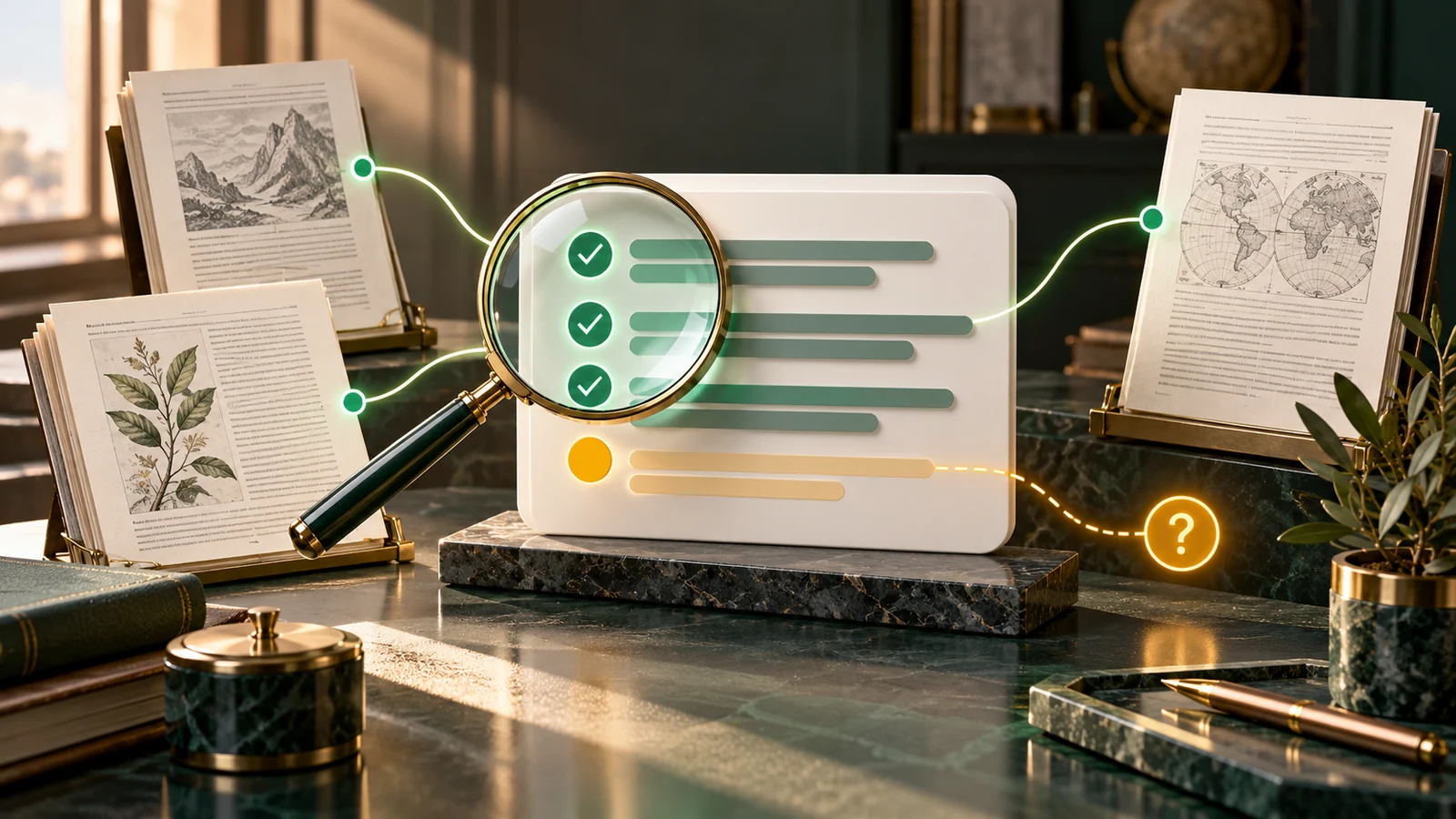
Fact-check AI answers by separating the answer into individual claims and checking each important claim against an appropriate source. Verify that the source exists, that it is current enough and that it actually supports the wording. Keep unsupported claims out of the final answer or state the uncertainty explicitly.
A citation can be real while the claim beside it is wrong. A confident explanation can also combine facts from different contexts. The verification task is to inspect the relationship between the claim and the evidence, not merely count links.
Start with a claim ledger#
Break a paragraph into statements that can be checked independently. Prioritize claims that affect a decision, numerical results, current availability and statements about another organization's product or policy.
| Claim ID | Claim type | Evidence needed | Review status |
|---|---|---|---|
| C-01 | Product supports a format | Current official documentation | Unverified until checked |
| C-02 | Report total is 170 | Source data and reproducible arithmetic | Recalculate |
| C-03 | A study found an effect | Original study and relevant result | Check context and design |
| C-04 | A rule applies today | Current authoritative rule and scope | Verify date and jurisdiction |
The ledger is an original working template. Adapt the priority to the consequence of being wrong. High-stakes decisions may need qualified review and a stronger evidence process than a general article draft.
Copy this verification prompt#
Create a claim-verification ledger for the draft below.
Purpose, audience and date context: [details]. Draft: [paste].
Provided sources and excerpts: [paste with URLs and dates].
Separate factual claims, calculations, interpretations and opinions.
For each important claim, identify the exact supporting passage or
mark it unsupported. Check scope, date, units and whether the wording
is stronger than the evidence. Do not invent sources or claim to have
opened a page unless the tool actually retrieved it. Return a revised
draft that preserves uncertainty and removes unsupported assertions.
If the tool cannot browse, it cannot verify current pages on its own. You can provide retrieved source material, but still inspect the original source when the decision requires it. A model's statement that a link is valid is not evidence of a successful fetch.
Check source identity first#
Open the URL and inspect the publisher, title and date. Watch for a link to a search result, an unrelated homepage or a document with a similar title. For scholarly work, compare the authors, publication year and identifier with the actual paper.
Prefer primary sources for product behavior, technical specifications and original research. Secondary sources can help explain context, but check the underlying evidence for consequential claims. A vendor's marketing page can establish what the vendor says, while independent performance claims may need a different kind of evidence.
Check what the source actually establishes#
Read the relevant section and its conditions. A feature may be available only in a specific plan or region. A research result may concern a narrow population or task. A policy may have exceptions. Preserve those qualifications in the claim.
Do not let the model use a broadly relevant source as support for a precise unsupported number. If a page discusses efficiency but does not provide the claimed reduction, that citation does not validate the statistic.
Recalculate numerical claims#
Check units, denominators, date windows and rounding. If a draft says an increase from 20 to 25 is 5%, the arithmetic needs clarification: it is an increase of 5 units and 25% relative to 20. If the values are percentages, a change from 20% to 25% is five percentage points.
For totals, preserve the source rows and calculation. For estimates, record assumptions. A neatly formatted table can contain invented precision, so ask where each value came from and whether it is observed, calculated or assumed.
Use independent evidence for the main conclusion#
Asking the same model “Are you sure?” can produce a more confident version of the same error. Use the original source, independent arithmetic or an appropriate expert reviewer. A second model can offer a useful challenge, but agreement between models is not proof.
NIST's Generative AI Profile discusses risks including confidently generated false content. The practical response in this guide is a traceable verification record, not a claim that one prompt eliminates hallucinations.
Keep uncertainty visible in the final version#
Use wording that matches the evidence: confirmed, estimated, proposed or not established. Remove claims that add no value and cannot be supported. If sources conflict, describe the conflict and identify what would resolve it instead of selecting the more convenient answer silently.
Store the claim ledger with the final draft and the date of verification. Current claims need review when the product, rule or source changes. A one-time check does not make a statement permanently accurate.
Use the AI data analysis checklist for calculations, product comparison evidence for specifications and the literature review matrix for research claims.
Common questions#
Does a citation prove an AI answer is correct?#
No. Check that the source exists and that the specific passage supports the claim with the same scope, conditions and date context.
Can a second AI model verify the first model's answer?#
It can suggest challenges or missing checks, but shared errors are possible. Use primary evidence and reproducible calculations for the important claims.
What should I do with a claim I cannot verify?#
Remove it, narrow it to what the evidence supports or state that it remains unverified. Do not turn a plausible assumption into a fact merely to complete the draft.
Download the working files#
Download the copyable prompt and download the illustrative worksheet (CSV). Replace example data with your own verified inputs; the worksheet is a planning aid.
Browse the English AI workflow guides for related tasks.
Put the workflow into practice
Start with the copyable prompt and a small example you can verify. Choose a tool that supports your input type, and review its output before using it.
Open GPT PlusThe app interface is primarily Persian. Available models and tools are shown in the app.
Continue with a related guide

Analyze Customer Interviews with AI Without Losing Context
Analyze customer interviews with AI using traceable quotes, a codebook and a theme matrix. Separate observations from interpretations with a ready-to-use prompt.

Build a Knowledge Base from Support Tickets with AI
Turn resolved support tickets into accurate knowledge base drafts with AI. Includes an article template, evidence checks and a repeatable maintenance workflow.

AI Support Ticket Classification: Taxonomy, Prompt and QA
Classify support tickets with AI using clear category rules, an abstain option and a labeled evaluation set. Includes a routing matrix and JSON prompt.